
Edge AI in Manufacturing - 2025 Trends
From Automation to Measurable Operational Advantage
Manufacturing is undergoing a structural shift as Edge AI moves from isolated pilots into core operations. Unlike cloud-centric analytics, Edge AI enables perception, diagnostics, and control directly at the machine level where decisions impact throughput, quality, and cost in real time.
Real-Time Quality Inspection
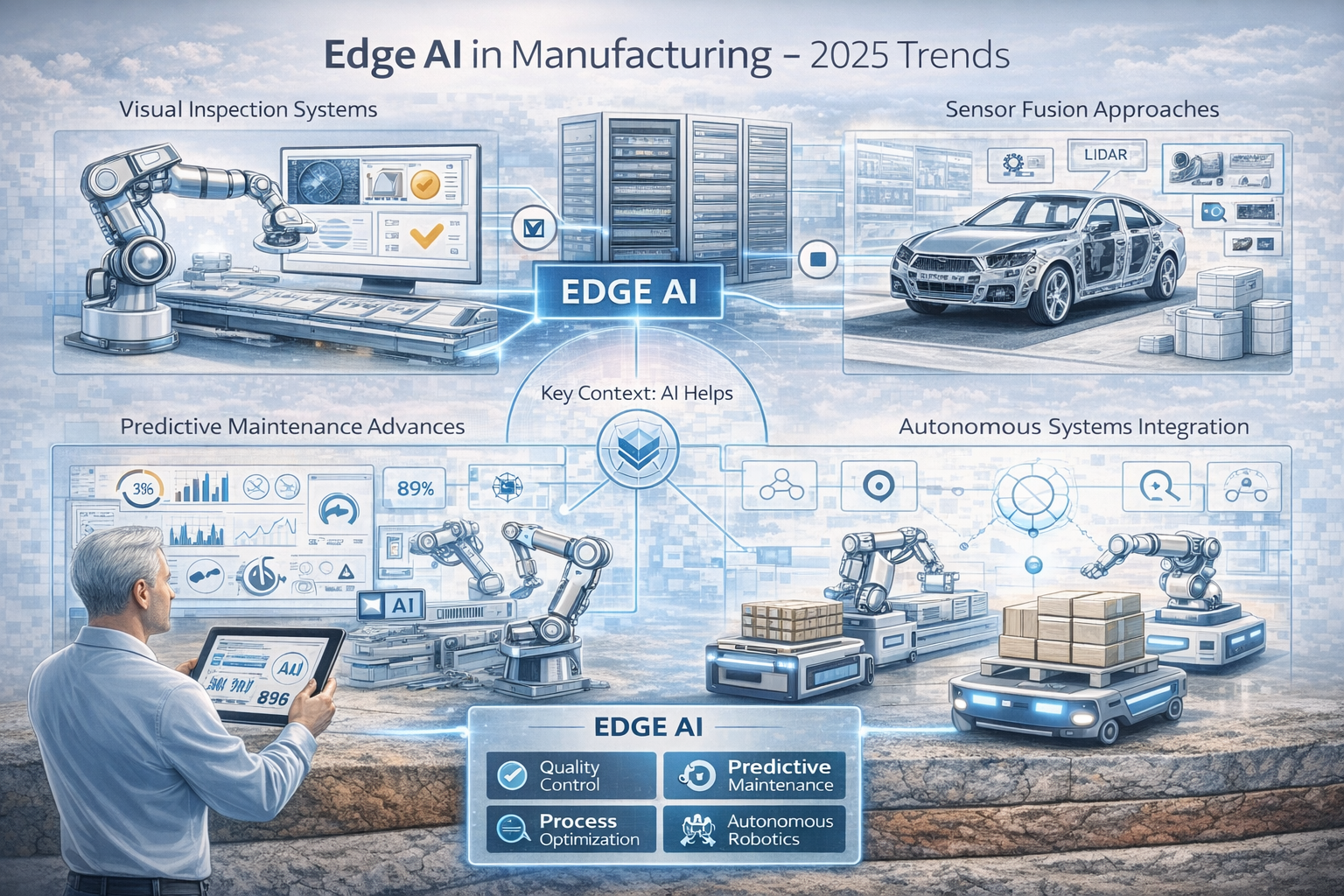
Edge AI enables quality inspection at full production speed. Vision systems now detect defects in-line using multi-camera coverage and transfer learning to scale across product variants. Explainable AI supports quality documentation and traceability, reducing scrap, rework, and customer returns.
Business impact: manufacturers consistently report 15–40% reductions in defects and scrap, faster root-cause identification, and improved first-pass yield.
Sensor Fusion for Quality and Integrity
Quality control increasingly relies on multi-modal sensing. Edge AI fuses data from thermal imaging, acoustic analysis, machine vision, and surface metrology to detect thermal stress, structural issues, dimensional variation, and surface defects that single sensors miss—improving consistency and reducing hidden failure risk.
Predictive Maintenance at Scale
Predictive maintenance has matured through more accurate remaining useful life estimation, coordination across multiple assets, and tight integration with ERP and MES systems. Synchronization with digital twins enables simulation-based maintenance planning and smarter spare parts management.
Business impact: Edge AI–driven maintenance delivers 20–50% reductions in unplanned downtime and 10–30% lower maintenance costs, while improving asset availability.
Autonomous and Self-Optimizing Systems
Edge AI is accelerating autonomy on the factory floor. Collaborative robots operate safely alongside humans, material handling systems adapt dynamically, and production lines self-optimize in response to changing conditions. Automated changeovers reduce setup time and increase flexibility without sacrificing quality.
Implementation Considerations
Successful deployment requires robust edge infrastructure, secure data governance, integration with existing MES and ERP systems, and workforce upskilling. Edge AI delivers value when it is embedded into operational workflows not layered on top as another analytics tool.
Market Outlook and Business Impact
Adoption is accelerating due to labor shortages, rising OEM quality requirements, energy efficiency mandates, and supply chain resilience pressures. Manufacturers investing strategically in Edge AI are realizing 5–15% throughput improvements, faster response to variability, and stronger margin control.
The Bottom Line
By 2025, Edge AI in manufacturing is no longer optional. It is foundational to competitive operations. Organizations that treat Edge AI as operational infrastructure not experimentation will lead in productivity, quality, and profitability.