
Energy Digital Transformation - Project Insights
ENERGY DIGITAL TRANSFORMATION – PROJECT INSIGHTS
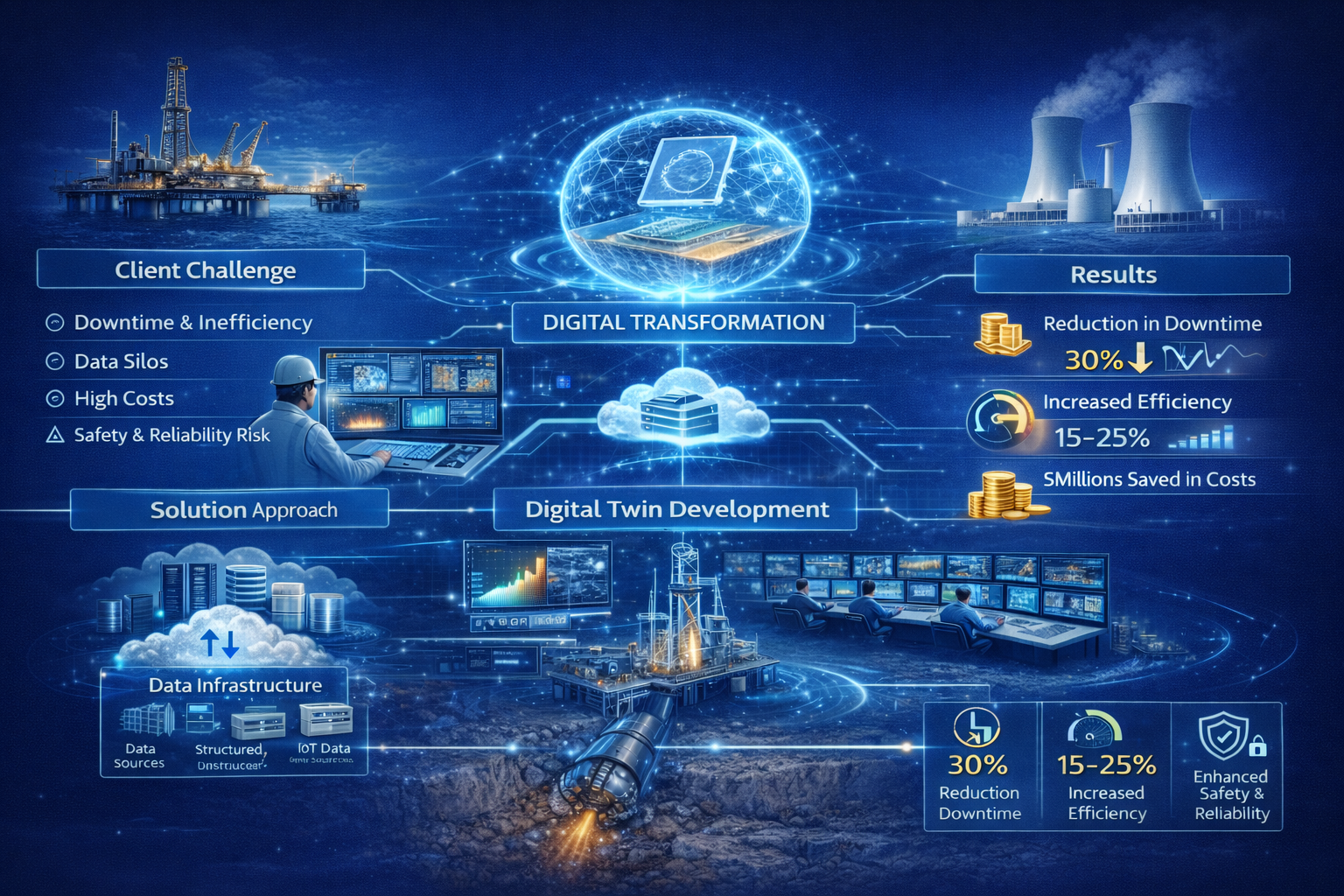
This case study examines the deployment of a comprehensive digital twin and edge analytics solution for a leading energy company operating a mix of onshore and offshore assets. The initiative was designed not as a technology upgrade, but as an operational transformation focused on reducing downtime, lowering maintenance costs, and improving asset availability across diverse operating conditions.
THE BUSINESS CHALLENGE
Both onshore and offshore energy operations face significant economic exposure from equipment failures and unplanned downtime. The client struggled with high levels of reactive maintenance, limited real-time visibility into asset health across distributed facilities, and increasing difficulty transferring operational knowledge from experienced personnel to newer teams. These challenges directly impacted production targets, safety margins, and operating costs.
SOLUTION APPROACH
The program was executed through a phased digital transformation approach to ensure early value delivery while establishing a scalable foundation applicable across both onshore plants and offshore platforms.
PHASE 1: DATA AND EDGE INFRASTRUCTURE
Edge computing infrastructure was deployed across onshore facilities and offshore locations to enable low-latency analytics and resilient operations. Secure data pipelines were established to the cloud, integrating existing SCADA and historian systems into a unified, real-time operational view.
PHASE 2: DIGITAL TWIN AND ANALYTICS DEVELOPMENT
Physics-based digital twins were developed for critical rotating and process equipment to capture real operating behavior and dominant failure modes. Hybrid machine learning models enabled anomaly detection and early warning, while real-time dashboards translated technical insight into operationally actionable information.
PHASE 3: OPERATIONAL INTEGRATION
Predictive insights were embedded directly into maintenance planning and operational workflows across both onshore and offshore teams. Operations personnel were trained on new processes, and continuous improvement loops were established to refine models, thresholds, and decisions as operating conditions evolved.
MEASURED BUSINESS IMPACT
The program delivered clear, quantifiable results that translated directly into production reliability and cost performance:
Unplanned downtime reduced by 30%
Maintenance costs reduced by 22%
Mean time to repair reduced by 45%
Asset availability increased by 8%
ADDITIONAL VALUE DELIVERED
Beyond the core metrics, the engagement improved safety through early anomaly detection, strengthened knowledge capture and transfer across onshore and offshore teams, and established a scalable digital foundation for future AI and optimization initiatives across the asset portfolio.
KEY LEARNINGS
Success was driven by strong executive sponsorship, close collaboration between operations and IT teams, and a phased delivery model focused on high-value use cases first. Embedding digital twins into daily workflows rather than treating them as standalone tools was critical to sustained adoption and value creation across diverse operating environments.
THE BOTTOM LINE
This engagement demonstrates that digital twins deliver the greatest value when implemented as operational infrastructure aligned to business outcomes. By shifting from reactive to predictive operations across both onshore and offshore assets, the client achieved measurable gains in reliability, cost efficiency, and production performance lying the groundwork for continued digital transformation at scale.