
PRODUCT & LIFECYCLE ACCELERATION
Shortening Development Cycles While Increasing Confidence and Quality
In many industries, product development is constrained by long test cycles, late-stage failures, and conservative decision-making driven by uncertainty. Physical testing remains essential, but when it becomes the primary source of learning, development slows and costs escalate. Lifecycle acceleration requires moving insight earlier without increasing risk.
The Business Problem
Extended design–test–validation loops directly impact revenue and margin. Late design changes drive rework, over-testing inflates cost, and uncertainty forces conservative designs that leave performance on the table. Organizations need a way to move faster while maintaining confidence in safety, quality, and regulatory compliance.
Physics-Driven Acceleration
Physics-based simulation forms the backbone of accelerated development. Finite element analysis (FEA), computational fluid dynamics (CFD), and multibody dynamics (MBD) allow teams to explore design space virtually, identify failure modes early, and predict real-world behavior before physical prototypes are built. This shifts learning upstream, where changes are cheaper and faster to implement.
AI and Machine Learning as Enablers
AI and machine learning do not replace physics—they amplify it. Machine learning accelerates parametric studies, identifies patterns across simulation, test, and field data, and synthesizes large result sets into decision-ready insight. AI also supports faster model calibration, uncertainty quantification, and continuous improvement as new data becomes available.
Closing the Loop Across the Lifecycle
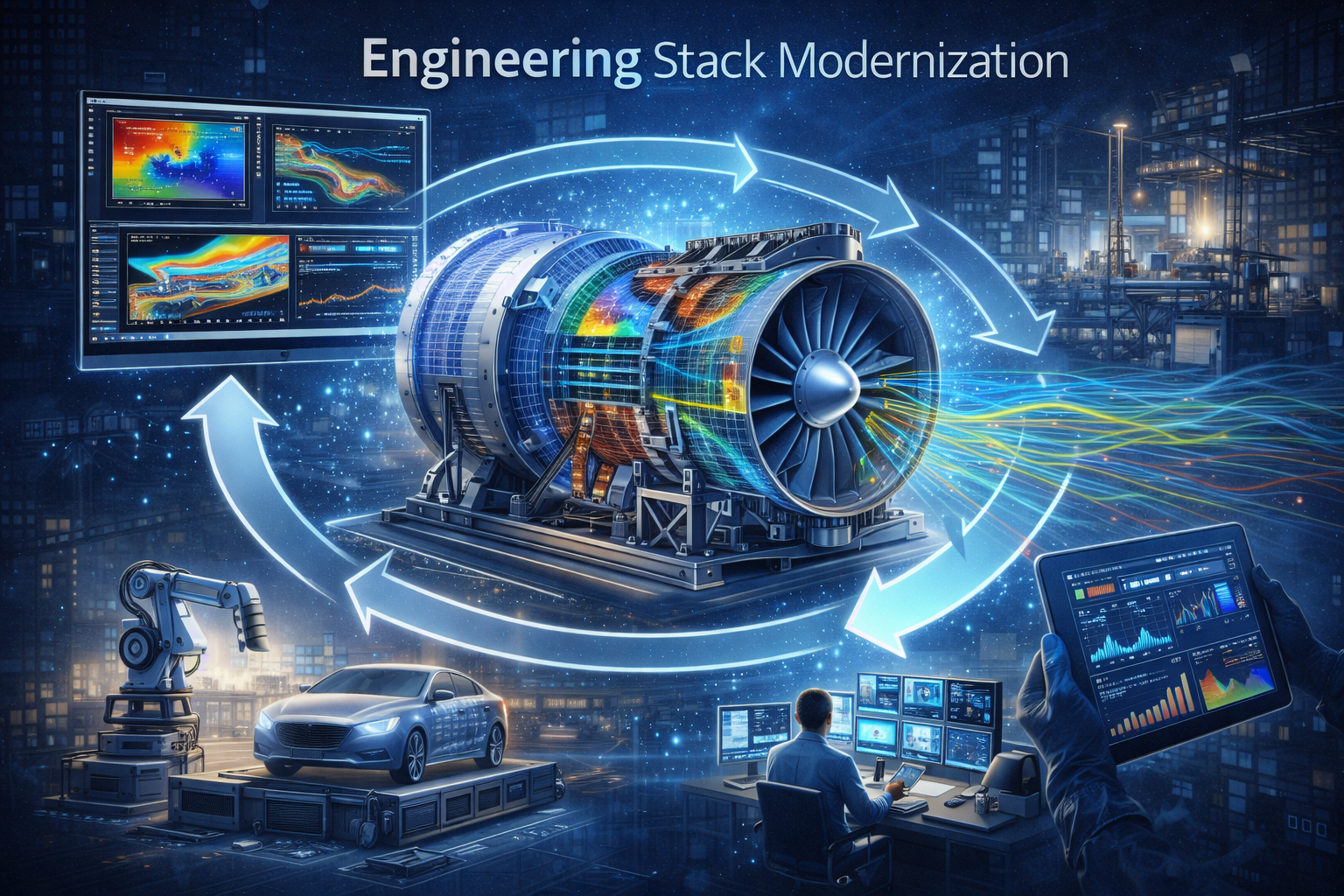
High-performing organizations close the loop between design, testing, and operation. Simulation informs test design, test results validate and refine models, and field data feeds back into performance prediction. This closed-loop approach reduces surprises, increases release confidence, and continuously improves product performance over its lifecycle.
Measurable Business Impact Organizations adopting physics-driven, AI-enabled lifecycle acceleration consistently achieve:
20–40% reduction in design and validation cycle time
15–30% reduction in physical testing and prototyping costs
Fewer late-stage failures and redesigns
Higher first-pass qualification and release confidence
Improved product quality and lifecycle reliability
From Speed to Competitive Advantage
Lifecycle acceleration is not just about moving faster—it is about making better decisions sooner. Physics-based insight reduces risk, AI-driven synthesis increases decision velocity, and closed-loop learning creates a competitive advantage that compounds across products and programs.
The Bottom Line
Product and lifecycle acceleration succeeds when physics leads and AI enables. By combining high-fidelity simulation with intelligent data synthesis, organizations shorten development cycles, improve quality, and deliver differentiated products to market with confidence.